The Leap Of Faith
From commercially-curious academic to research-grounded entrepreneur
By Dr Benjamin O’Brien
16 March 2026
Executive Summary
Many researchers are curious about starting a company but haven’t convinced themselves to take the leap of faith and do it. There is not much support out there for navigating the obstacles that hold people back. Starting a business is as big a life step as getting married, moving countries, or leaving school. There are very real risks to be navigated, skills to be learnt, and hard decisions to be made, and we just sort of hope people will figure it out on their own. This is a huge problem for all of us. The emergence of founders is the bottleneck step in the creation of startups from research. If we want more companies, we need more founders. This essay aims to directly help researchers tackle the issues holding them back in the hope that more take the leap of faith and start some fantastic new companies.
Introduction
Many academics are interested in starting a company but feel trapped. On the one hand, they are doing excellent research with the potential for commercial impact. On the other, there are numerous obstacles in the way of becoming a startup co-founder.
There are great resources [1] out there to help people start and grow companies. However, these tend to focus on problems that people face after they have made the decision to become a founder. How do you choose and validate a market, make a prototype, pitch for investment etc.?
These programs don’t focus on the problems you face before you have decided to become a founder. You feel that your technology isn’t ready, need to pay rent, are scared of upsetting your supervisor, unsure what applications are out there, have a grant submission due, and are worried about losing your secure academic career.
This leaves commercially curious academics feeling gas-lit. You can see the opportunity, understand the need to acquire commercial skills, and want to make progress, but because of personal barriers are unable to fully engage. The system doesn’t help with the problems you actually have and hopes you will somehow make the decision to become a founder on your own. Sooner or later the opportunity passes you by, leaving us all a little worse off.
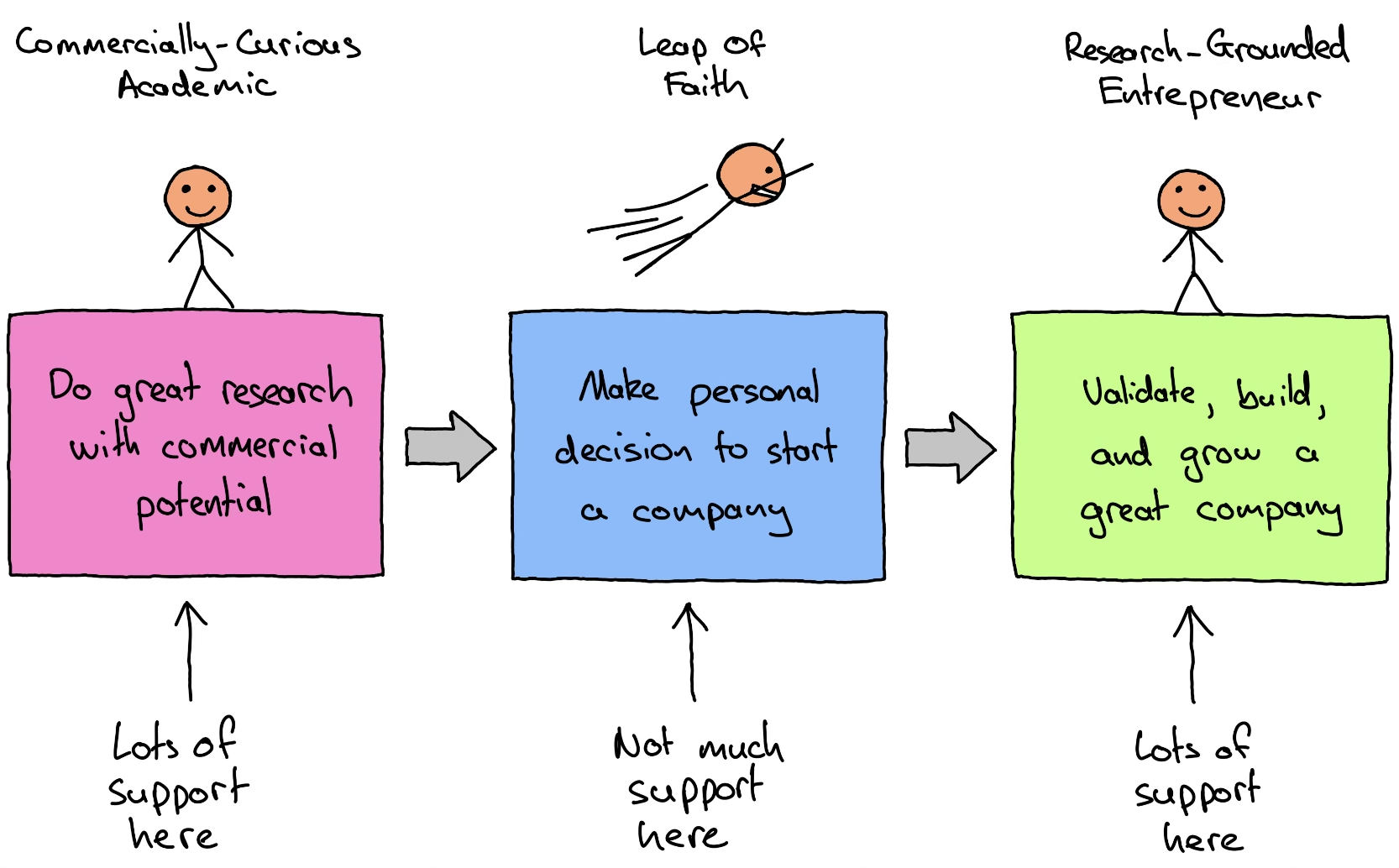
This essay tries to help people navigate the leap of faith from commercially-curious researcher to research-grounded entrepreneur. We will discuss why we want companies in the first place, how companies are spun out of research, and why the emergence of founders is the bottleneck process. I will then present a simple framework for identifying and dealing with barriers in your way, and discuss some common problems people face.
I focus on early career researchers because this is the largest group of people in a position to start companies based on research. However this is not meant to be exclusionary! Please pass this piece to any researcher you know who is thinking about starting a company. Whatever stage you are in your academic career, the basic points should still apply and I encourage you to give it a go. I also hope to help people in research institutes and the startup ecosystem to better understand and support the emergence of new research-grounded entrepreneurs.
This essay is entirely my own thoughts and opinions. It doesn’t represent the opinions of any companies or organizations I work for or contract to. It was written in a New Zealand context, but I am sure much of it applies elsewhere. Also thank you to the many people who read my drafts and provided feedback!
The benefits of starting companies
Starting companies bring us many benefits. I think about it at three levels - personally, for society, and for the country.
The personal reasons for starting a company are strong. A life spent helping people can provide you with meaning and purpose. Fundamentally, a business is a machine for solving other people’s problems. It is addictive to help someone solve their problems, they thank you gratefully, and then even give you money!
Running your own business is empowering. You get to decide what you are going to work on and how to get there. This sense of freedom and autonomy is a big reason for why people become entrepreneurs.
Starting a company is hard. You will make many mistakes and suffer many setbacks. This is incredibly rich learning that will set you up for the rest of your career, whatever you do. In fact, as a leader in a startup you will learn far more than you would think. This is because you are served a constant diet of all the hard problems in the company that no-one else could solve. Painful in the moment, invaluable later on.
And, of course, a startup can make you wealthy. Not just you, but your employees, suppliers, customers, partners, investors, family, and all the people around you in a community. I don’t believe that wealth is the highest aspiration for a person, but poverty is a blight and money gives you options to help others and tackle big problems. You can’t pour from an empty bucket.
New companies help the communities they are embedded in locally, but they also help society as a whole, especially when they are based on research. When you develop some new innovation it needs to get out into the world. Businesses are one of the best mechanisms we have for distribution of social good. Think of all the businesses involved in the supply chain to get you a medicine when you really need it.
Startups crystallise research into tools that others can build on top of. Go to any lab, of virtually any discipline, and you will see equipment floor to ceiling that once began as research. The compounding effect of knowledge being packaged as products so society can create more knowledge is the mechanism that sprung humanity from the Malthusian Trap.
And win, lose, bankruptcy, stable profits, or massive exit, the founders of startups give back to their communities with lessons, support, and investment. This even happens unconsciously when it doesn’t work out. Employees of failed startups get a master class in what not to do when they start their own company.
For the country, startups are where the new jobs come from. When a new company grows it creates jobs and hires people. Already established companies don’t make as many new jobs because they have saturated their markets.
Startups are an engine for solving critical national problems, whether these be medical, environmental, or anything else. They build new industries that give countries the exports needed to create value on the international stage. Value = leverage = independence = more secure life for everyday people.
Successful startups drive growth in the economy, and this allows an increased tax take. You might think this is boring but tax is essential so that we can have the things we like in society, like nurses, firefighters, roads, and schools. These economic reasons are why successive governments continue to try and increase the number of startups.
The kinds of companies that create the most value are based on new technology and new discoveries. The biggest benefits to country, society, and you personally are most likely to come out of research. This is why I am writing this essay for researchers, early career researchers in particular, because you are the people who can unlock all these benefits for everyone.
How companies are spun out of research
The process of spinning a new company out of a research environment follows three basic steps; build an engine of research, found a company, build it into a successful startup.
Building an engine of research is critical. You and your team need to be the best in the world at something. This could be a novel innovation, a system you built, something you discovered, or a capability you have in an emerging field. Being one of the best gives you the ability to solve problems that others can’t and gives you a head start on your competition.
Engines of research are built in a positive feedback loop that concentrates results, funding, people, infrastructure, and skills in one place. As the team makes progress against a problem they earn the right to larger amounts of funding and attract more people and talent to the team. The team uses this human and financial capital to build infrastructure in the form of tools, equipment, software, processes, collaborations and whatever else is needed to do the research. The team develops the skills to use this research infrastructure and produces new knowledge which is then published. This earns the right to more funding and the cycle repeats.
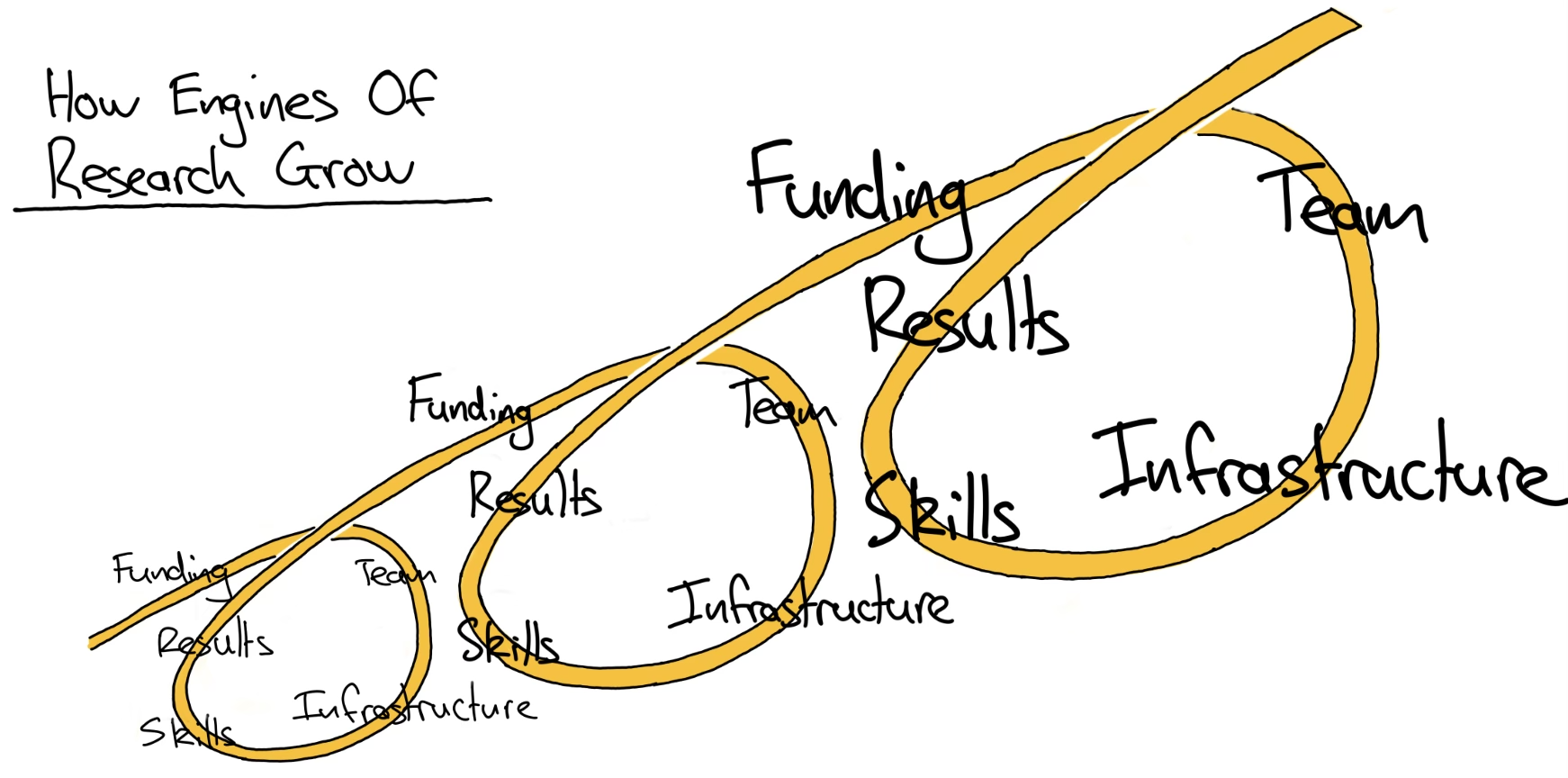
Once an engine of research is built it starts to produce a stream of skilled researchers and intellectual property. It attracts the notice of people in the world with problems and other people with capital. All of this - the researchers, IP, infrastructure, problems, and capital mix to create a pool of latent opportunity.
This opportunity coalesces into a company when a founder, or small group of founders, takes a leap of faith to start a business. They quit their jobs (or make time for a side hustle), decide which opportunity to focus on, and start the work of running a startup. Building prototypes, winning early customers, changing direction based on what they learn, and recruiting people to their dream.
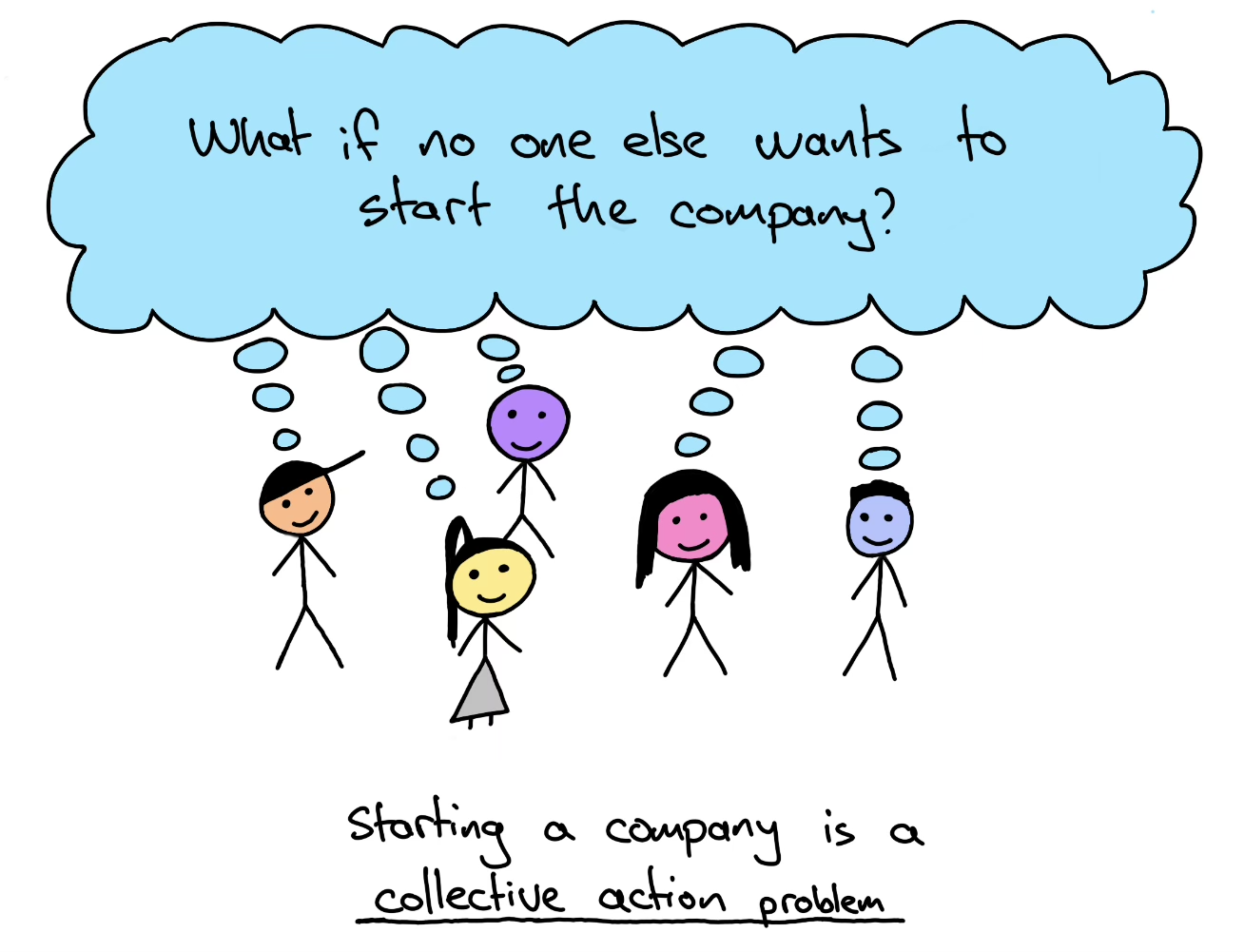
The founding team is essential because forming a company is a collective action problem. When the company doesn’t exist, anyone joining it is taking a big risk. Once the company is up and running with a team, clear mission, customers, a product and funding then joining it is a much smaller risk. The founder’s job is to take the initial risk that others will join them. Founders manage this risk by lining up people ahead of time, by becoming excellent at pitching and persuading, and by systematically reducing personal risk for themselves (spoiler - this is the skill you will need to learn!).
You also need founders because companies must focus. Research is by its very nature open ended. This is the beauty of it and a large part of where engines of research develop their value. However, to actually make a product work in the world there is so much more to be done than the initial insight. The only way you work through all this other stuff is continual focus over time. The founder’s job is to bring that focus.
Once the company is set up a large support network of people swing in to help the team validate and build their business. Universities, technology-transfer offices, mentors, investors, service providers, accelerators, peer support networks families, suppliers, early customers. All these people want to help you succeed and grow and will provide you with the repeatable parts of the startup journey. All startups will need to do accounts, access networks of mentors, and write a business plan. You will need to learn things like how to sell, negotiate a term-sheet, manage a project, or hire people.
Of these steps, build engine of research -> take leap of faith -> grow great startups, it is my humble opinion that the leap of faith is by far the largest bottleneck in the creation of companies. Without people taking the leap, capability pools in the research institute and the startup ecosystem is starved of early stage opportunities.
Why is the leap of faith so hard?
Successful engines of research don’t naturally create any pressure for people to leave and start companies. If you are good at generating and communicating research outcomes, the system rewards you with steadily increasing responsibilities. You attract PhD students, win grants that have long term deliverables, find yourself on funding bodies and organising conferences. You slowly stop being an independent researcher and become a system enabler and part of the research engine infrastructure.
This accumulation of obligations makes it increasingly difficult to leave. It also shifts your time horizon. You naturally set your cadence of work by things like the aforementioned conferences, grant deadlines, PhD submissions, teaching loads etc. This conflicts with startups that need to move fast to capture opportunities before they disappear. In fact, it is usually only when the research engine starts to fail due to a lack of funding that people look for other opportunities, be they jobs or starting a company or something else.
On the other side, support for startups focuses on the most promising companies. Staff and mentors gravitate to the most exciting mission. Investors are looking for power law returns. The government doesn’t want to support failures with taxpayer money. Everyone wants to help a success.
This is completely fine and normal. Resources should concentrate on the most promising ventures and those that don’t work out should be wound down, freeing up people and money to work in more productive areas. The problem is that, like I said in the introduction, most commercially curious researchers haven’t convinced themselves to start a business.
If you as a researcher haven’t convinced yourself, you won’t put the work into convincing others. You won't spend meaningful amounts of time, attention and energy working on the company. This means that you never clear the bar for being a promising enough venture to attract real support.
You disengage from the startup ecosystem and drift back into the academic world. Eventually the opportunity passes you by and a potential startup is lost forever. I have updated my drawing from before to fully show this state of affairs. The three factors combine to make it very hard to take the leap of faith.
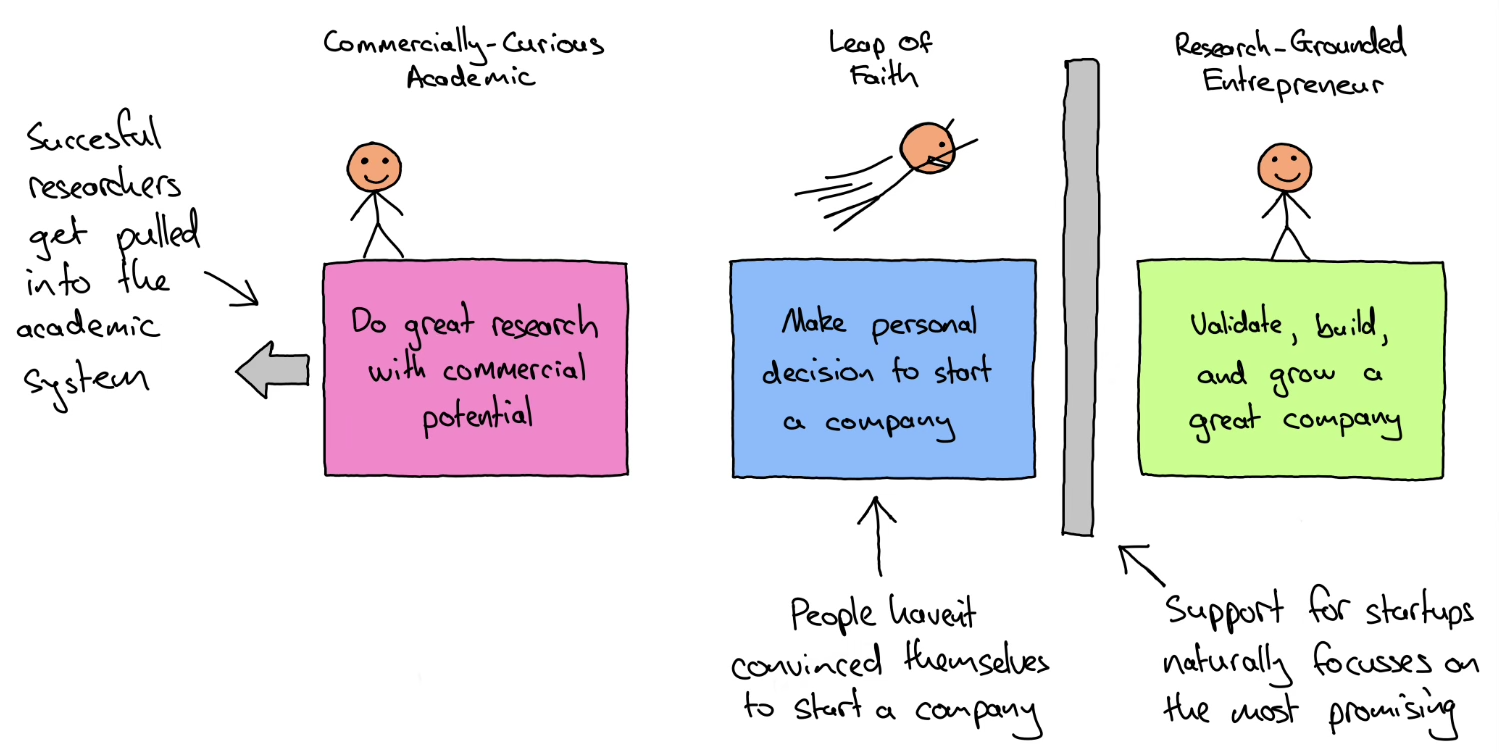
Ecosystem providers can sometimes be bewildered by this dynamic. They pour more resources into education, make available more funding than ever before, play with tax settings, build structured programs. And yet the pipeline of new science and technology companies remains stubbornly small. The academics are still not engaging. This is a huge problem because we need more startups coming out of research.
Some interventions are being tried - there is pressure for academics to show commercial outcomes in their research in order to get grant funding. But without the decision to be a founder, academics can treat this as an exercise in “business-washing”, i.e. adding aspirational commercial statements to grant applications they have no deep intention to follow.
I believe the ecosystem [2] is not putting enough effort into understanding why the researchers can’t convince themselves to start a company, and how to help them navigate this journey. So, let’s see if I can convince you.
How to convince researchers (you) to start companies
The people who can best convince researchers to start companies are the academics themselves. Specifically early career researchers (ECRs). ECRs are the people typically doing a masters or PhD, or in the first few years of a post-doc. They have had time to advance to the frontier of knowledge, have practical skills from being on the tools, and haven’t yet accumulated much responsibility in the university system. If this is you, consider this a friendly call to arms.
Right now I can imagine you reading this and saying something like:
“OK I get it. Society needs new companies. New founders are the limiting factor for new startups. ECRs are best placed to become new founders. I am an ECR who has developed something that could be turned into a business. Fine. But there are so many barriers in my way. I don’t want to risk my academic career. I have finally landed a post-doc position. I need to pay rent and eat. My partner doesn’t want me to do it. I’m not even sure if the opportunity is real and my technology still needs work. These are real barriers you can’t just hand wave away with quasi-patriotic appeals”
If this statement reflects your thinking then you have already taken the first step of identifying your blockers. Most people never consciously articulate what is holding them up. After all, we already discussed that neither the academic or startup ecosystems are pushing you to think about what is holding you back personally.
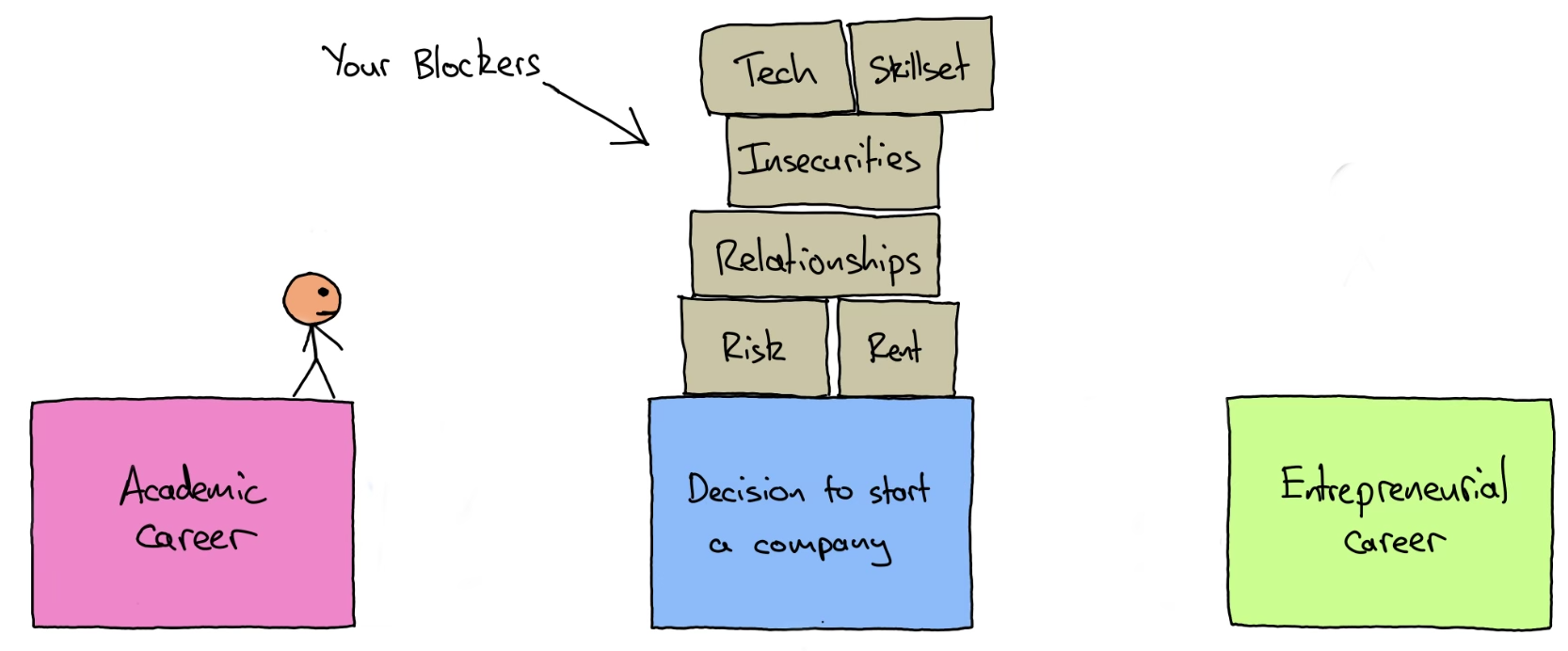
My proposal is simple. If you have interest in starting a company write down the things that are actually getting in your way. Be deeply honest with yourself. As well as reasons like risk, money, market, or technology readiness, also think about things like do I feel imposter syndrome? Am I scared of talking to my supervisor? Am I worried I won’t be able to learn business skills fast enough? Will my parents judge me?
Auditing your blockers does something magical. It takes a large, scary leap of faith and breaks it down into manageable pieces that can be grappled with. Once you have done this you can start to form a plan to address these blockers one by one. Your goal is to investigate, mitigate and manage the blockers until you get to the point where you either do take a leap of faith, or decide that the opportunity isn’t worth it and move on to something else. I suggest finding a whiteboard and a friend, write down the things really standing in your way, and brainstorm what you are going to do about it.
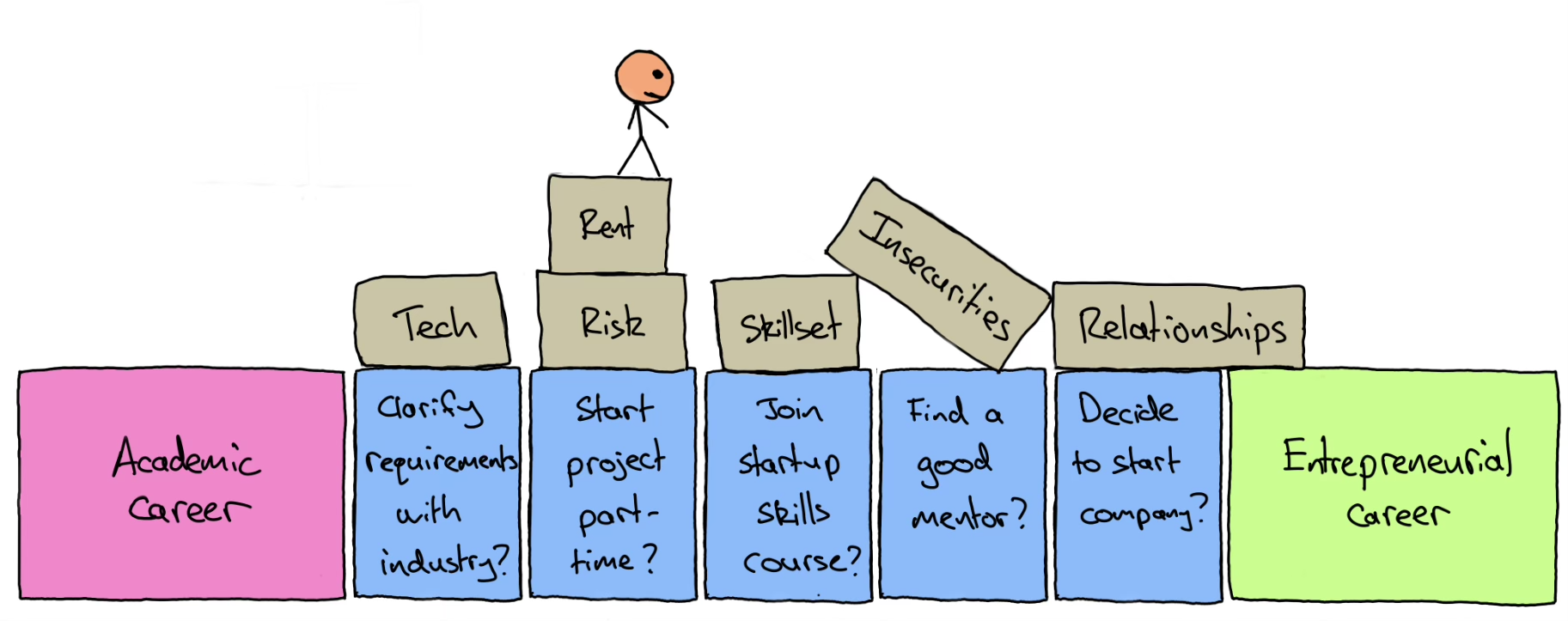
As a worked example, let’s consider personal financial risk. Researchers often rightly worry about giving up their position and regular pay-check. If you quit your job and the company fails then you are obviously in a tough spot. We can use the model of investigate, mitigate, and manage to see how you might deal with this.
Investigate: Model your financial situation in as much detail as you can. What expenses do you have? Any big events coming up? What savings do you have? Your goal is to work out what you actually need to generate from the company to justify leaving your job, and how long (if at all) you can afford to take a reduced salary if things go wrong.
Mitigate: Your goal is to reduce the personal financial impact should the company fail. There are many options which vary wildly depending on your situation. You could run the company as a side project, negotiate a sabbatical with your research institute, set a saving goal to hit before taking the leap, move back with your parents, or negotiate with your spouse and stagger when you take risks in your respective careers.
Manage: Your goal is to reduce your personal financial risk over time. As this is coupled to the business’s risk of failure, reducing business risk reduces your risk. Address the riskiest parts of your business plan first, whatever you are most unsure about is probably a good place to start. As your project starts to make money, don’t be shy about paying yourself what you need to manage your personal finances and accumulate for a rainy day. If you are raising money then ask for what you need to actually get the job done, which includes paying for your time.
Auditing your blockers in this way solves the deepest problem I see people grappling with: you don't want to commit fraud. I don’t mean the big capital F fraud of lying, stealing, falsifying documents etc. I mean the lower case f fraud of convincing people to do something that you don’t yourself believe in. When you feel blocked and uncertain you are not going to recruit and pitch to your friends and colleagues. This means that you are unable to solve the collective action problem. No one wants to be a hypocrite.
In contrast, if you are open and honest with yourself and with your friends and colleagues, then there is no hypocrisy. You are setting out your vision and also your uncertainty. This is the beginning of solving the collective action problem. People can see the actual problems and want to help. Some of those friends and colleagues notice areas that they can work on with you and will start to share their own barriers too.
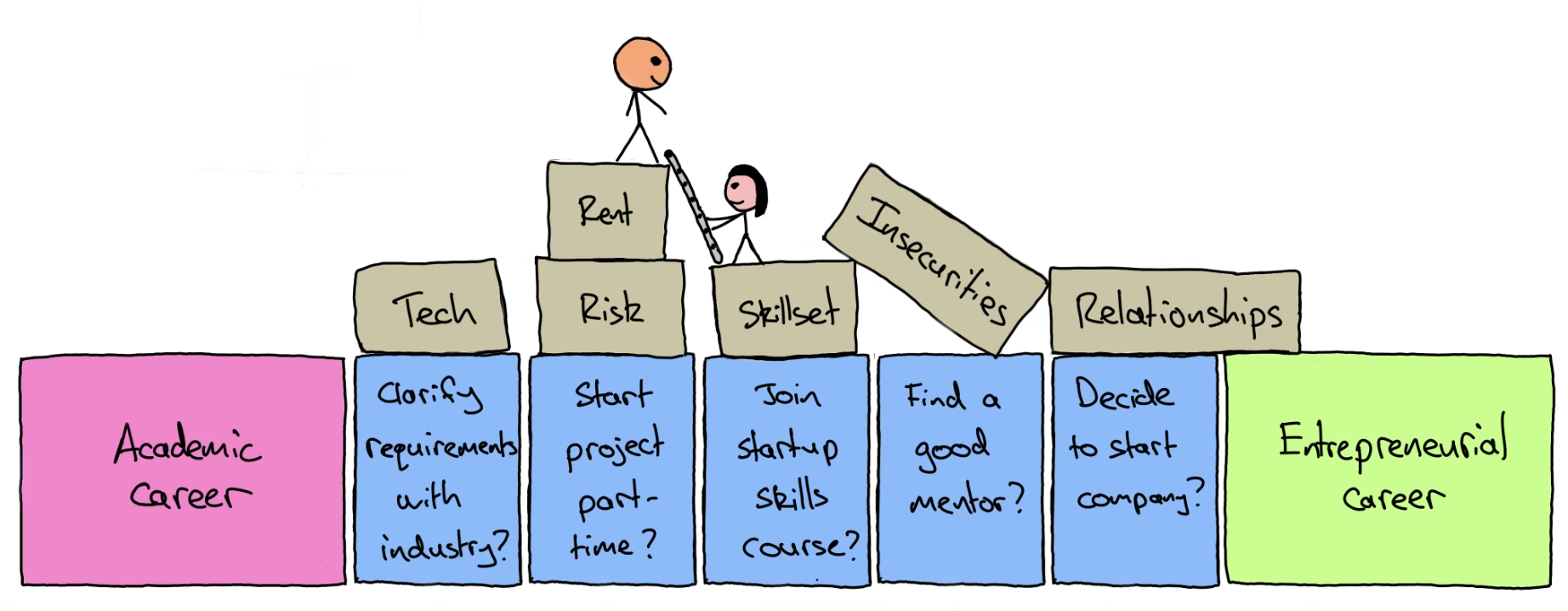
Being honest with your blockers also helps with ecosystem participants like accelerators, investors, and university tech transfer offices. These participants are allocating scarce time, attention and capital to founders and companies which means they are constantly weighing potential risk vs reward. Their biggest risk is that they give you funding and support and you decide not to launch the business. Therefore you become far more investable once you start to share your real problems. By being open about what is holding you back you reduce the overall risk of supporting you, help them understand where you are really at, and make it easier for them to help you deal with specific issues [3].
Investors also love to see traction - this means getting things done, learning and adapting, and making progress against your goals. If you present fake goals that you think investors want to see then you build a trap for yourself and will never show traction. Once you present your actual goals it becomes possible to show traction. A lot of founders try to solve this conundrum by telling investors and other funding bodies that they will start to work once they get the funding. Know that this is an instantly disqualifying death-knell for winning support to your business. The right way to do it is to be honest about what you are really struggling with, and to show progress on that.
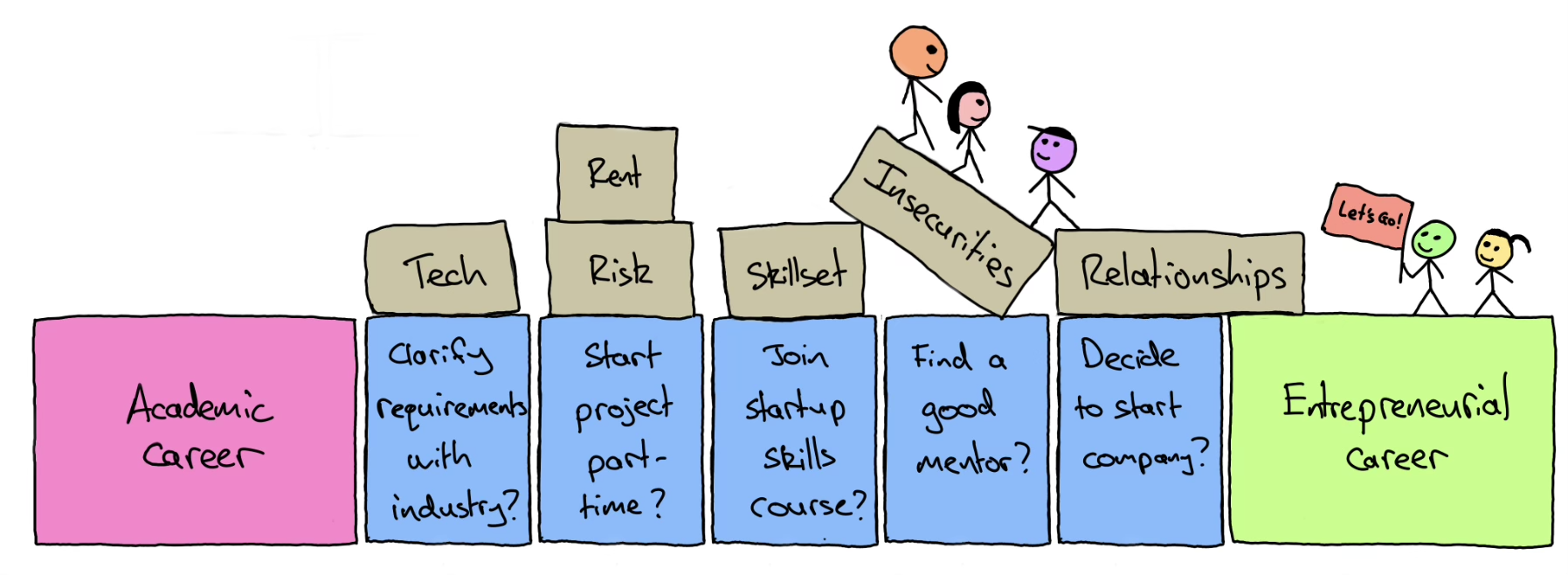
Entrepreneurship is largely risk management. By auditing your blockers and starting to work on them you are doing the real work of running a business, even if you haven’t incorporated it yet. You can build a business for years as a side gig, as a project, or within the research lab before incorporating. I believe you become a founder once three conditions are met:
You make the decision to identify the true barriers between you and embarking on a commercial enterprise.
You become comfortable talking to people about both your dream and the blockers.
You take action to investigate, mitigate, and manage the blockers.
Actually incorporating the company can come once you are ready.
And really, that’s it. Next I am going to discuss specific common objections. To summarise the core point: Early career researchers who want to start companies are often stuck contemplating barriers they don’t know if they can say out loud. The way to overcome these barriers is to be honest with yourself about your goals and what is holding you back. Once you do this you can take action, recruit others with a clear conscience, and ultimately decide to commit to an opportunity or move on.
Let’s do some Frequently Cited Objections.
FCO #1: Starting a company is too risky, I don’t want to leave my secure academic career.
This is a valid concern. Startups are risky and the whole point of the blocker audit is to help you manage this risk in a structured manner. I have three considerations when evaluating this risk.
The first is to work to turn decisions from one-way doors to two-way doors. A one-way door represents an irrevocable decision. For example, quitting your job or taking out a big loan to buy some lab equipment. A two-way door is a decision you can reverse if things don’t work out. For example, working on the company as a side project, and renting or borrowing the key lab equipment.
One-way doors increase the impact of taking a risk. Two-way doors reduce the impact of taking a risk and spread it out into smaller pieces. Any time you can turn risks from one-way to two-way doors you should do so. It frees you up to play, experiment and not worry so much about everything that can go wrong.
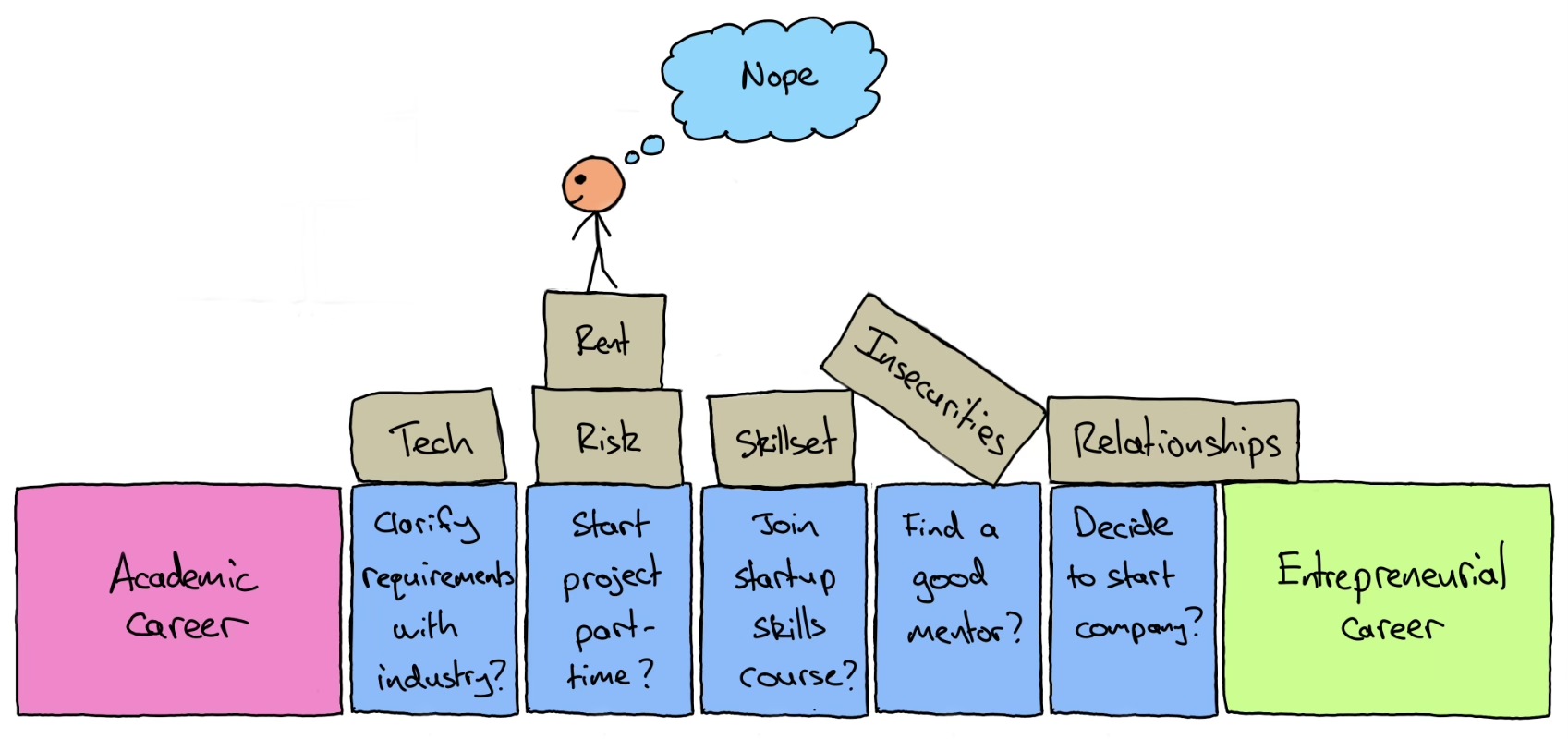
The second concept is to minimise your total career risk. I mentioned this in the beginning. If you start a company you will make lots of mistakes and learn lots of lessons. These lessons will pay enormous dividends for your future career. As a returning academic you will have a better understanding of the real problems out in the world. You will have better skills at pitching/making sales which translates into success with grants. You will have a bevy of interpersonal and management skills that will help you run research programs. You will also likely have some curly research questions unearthed along the way that you didn’t have time to pursue as a company. These curly questions could be the foundations for a new interesting research career.
It is true that you are taking short term risk. The company might fail. You might find it hard to break back into the academic career. The trick is realising that you are making a tradeoff. Take less risk upfront but maybe have a riskier career overall [4]. Or take more risk now, for less in the future. Only you can make the tradeoff. For example, if you just had a baby, have zero free time, are only just making your mortgage payments, and have a secure post doc for a few years, then probably you should stay as an academic for now.
The third concept is make sure you understand the structure of an academic career because it is probably more risky than you think. Academic institutions naturally form into hierarchies like professional sports. This is for two main reasons. 1. The total pool of money available from society for research is limited and can only grow slowly as the economy grows. 2. People who do good research benefit from the research engine cycle we talked about earlier. They rapidly accumulate more resources which means they do better research and thus climb to the top in a quasi-meritocracy.
The combination of fixed resources and exponential research engines causes university hierarchies to form into big pyramids with a small number of empowered individuals at the top (professors, deans, directors, chancellors etc.), and many relatively low powered individuals at the bottom (masters and PhD students, post-docs, technical staff etc.). It doesn’t really matter if the government allocates a larger or small percentage of the national budget to research, or if there are more or less admin staff. The fundamental pyramid structure of a hierarchy will remain.
This has a couple of consequences. The first is that it is zero sum. If a position opens up - say for an associate professorship - and you (as a post doc) get it, then it means that your friend can’t. There are always a smaller number of positions as you climb. It also means that the lived experience of anyone below some level in the hierarchy is chronic job insecurity. People live grant to grant, and often need to be supported by soft money from the institution to bridge them through gaps. Aside from the stress of financial insecurity, it is hard to work on larger goals when your source of funding constantly changes your priorities.
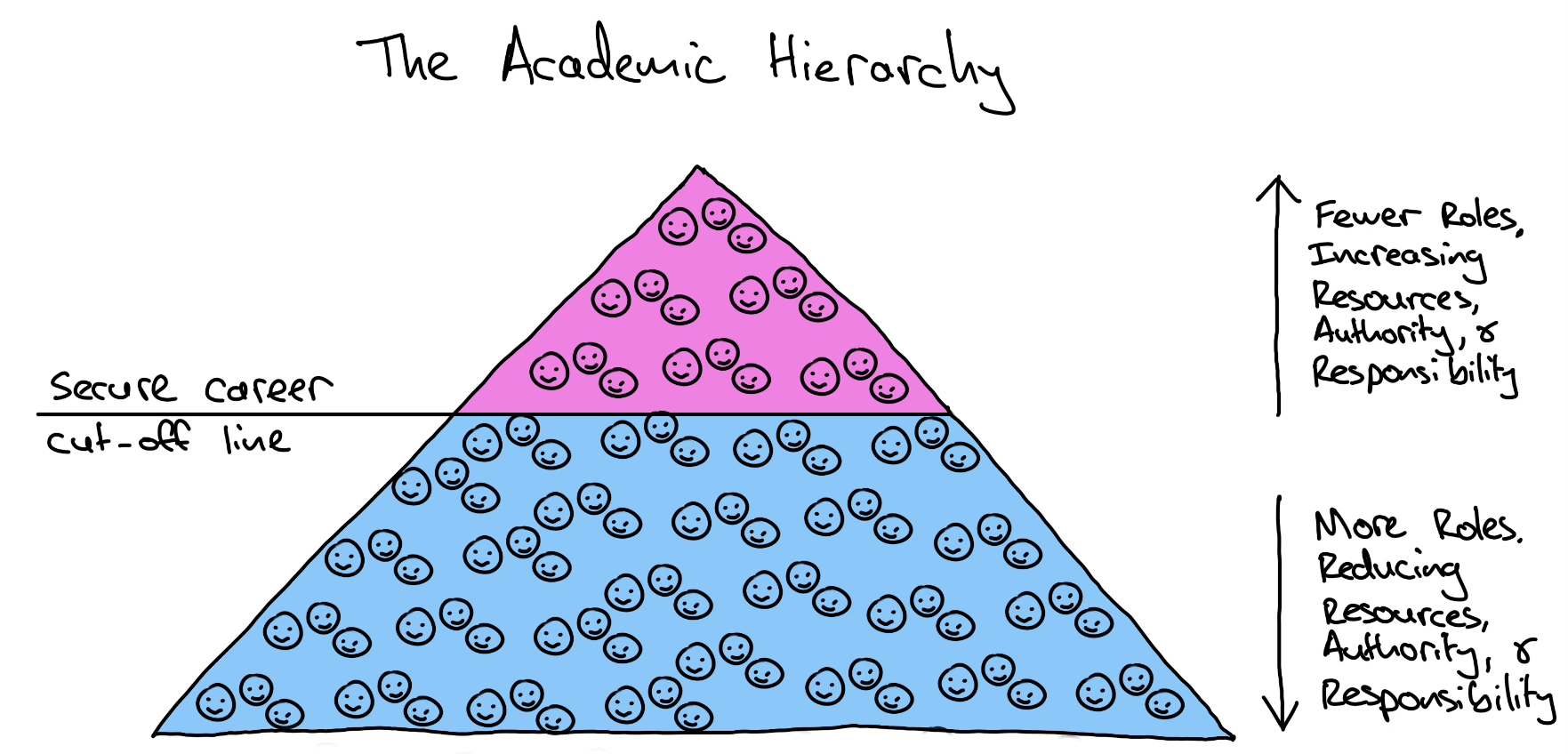
This means that for most people, statistically, you won’t be able to get a stable academic career. This is OK because academia also sets you up for other careers, like teaching, starting a company, or joining someone else’s. Like professional sports, people play to the level they want to and then switch careers into something else. There is no right career choice, the point I am making is to remember that an academic research career is only secure if you have passed a tipping point of research outputs, ability to bring in funding, and status in the hierarchy. If you haven’t crossed that tipping point then it isn’t very secure at all.
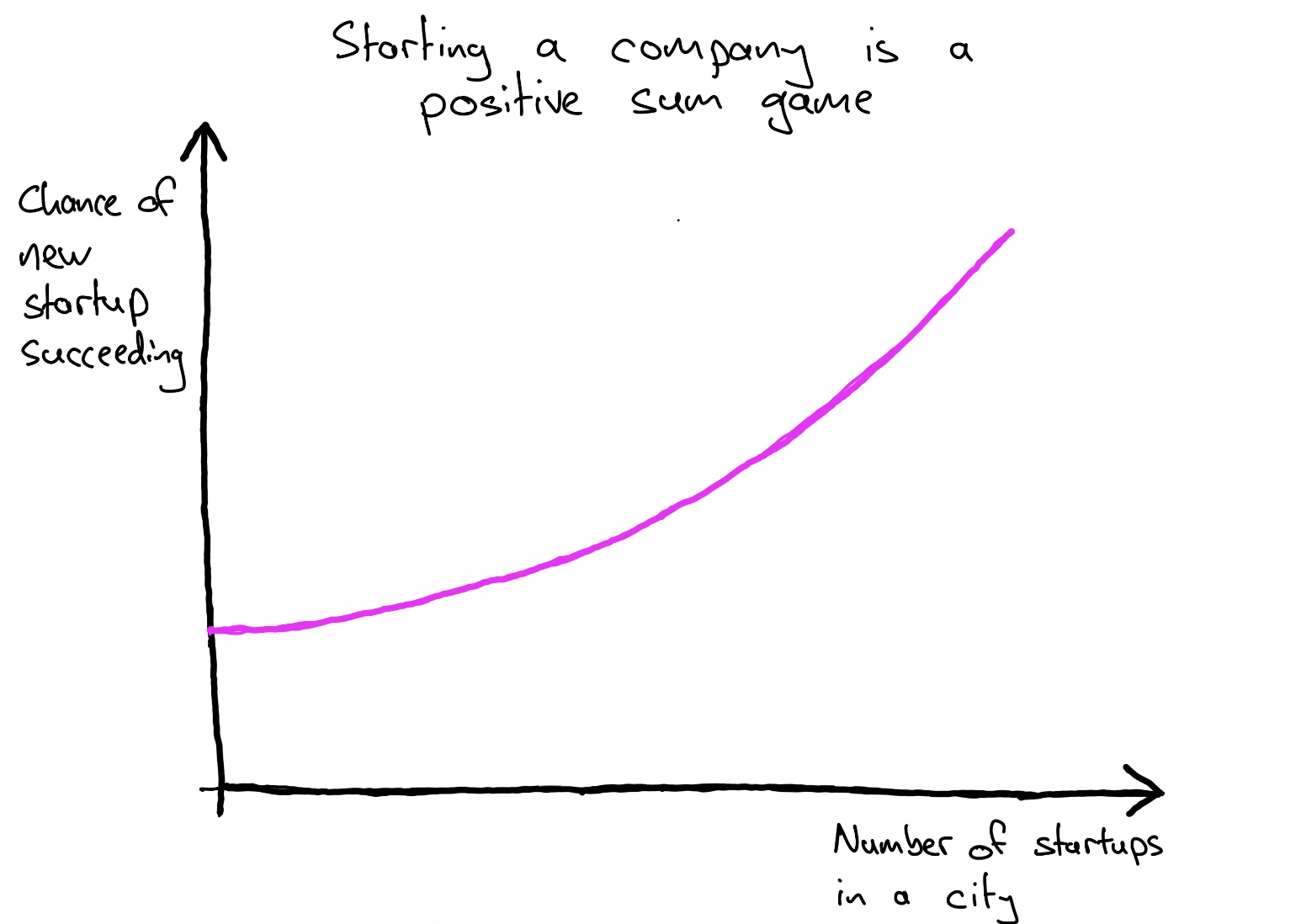
In contrast, startups are a positive sum game. As more companies are created they support a greater density of professional services provides, investors, and experienced mentors. The staff move from one company to another bringing skills and ideas that compound over time and make it easier for new business to get going. As business solve problems, they create new opportunities at a greater rate than they solve them. Anyone who has been in business will tell you that often the biggest issue they face is saying no to all the things they could be doing, to maintain focus. One person’s distraction is another person’s opportunity. This is why governments obsess about getting startup density to critical mass in a city. The marginal benefit created for society grows with every new startup.
FCO #2: I can’t convince my supervisor/parents/co-founders.
Interpersonal issues are often a problem for founders. Your parents want you to follow a particular career path. Your co-founders don’t see eye to eye. Your supervisor wants you to keep working in the lab because they are terrified about how they will replace you if you leave [5]. I think there are two big drivers sitting under these interpersonal conflicts.
The first is that you as the founder are making a transition from being low-status in a big organisation to being high status in a small one. This requires a radical rethink of your own identity and how you move through the world. Inside the big organisation you need to understand and follow the rules and respect the hierarchy. In your own company you are in charge. There are far few constraints. You are in charge of learning what works and putting rules and process in place to scale it up.
This professional development journey from low agency to high agency is difficult and will take time. You will need to renegotiate key relationships in your own mind, and then with the actual people themselves, and this is tricky. You need to learn to do things that you want to do – yes, respecting the stakeholders in your life, but ultimately with you in charge of yourself. This is part of Adulting.
Aside from the personal development, starting a company is a genuine rupture and reset in many relationships. Some people will join the company, some won’t. Your research institution may or may not have equity, a licence deal, or research contract with you. A key theme of this essay is that you probably haven’t looked closely at what you really want, what you believe, and what’s holding you back. Others won’t have done this either and when you spin out the business you are forcing them to make big decisions - but on your timeline and not theirs.
My observation here is that all these problems also exist if you stay in academia. You will still need to grapple with your parent's hopes and dreams. You will still need to work with colleagues and collaborators. You will still need to disappoint your supervisor when you move to a research group in a different country or get funding to work on your own thing.
Either way, you need to learn to navigate this stuff. My suggestion is the best thing you can do is find mentors. Whether you are in business or academia, cultivate relationships with people who have been there before, they will help you navigate these tricky spots in your life.
FCO #3 I gave too much equity to someone who decided to not join the company and now we are stuck in a big argument and I don’t know if we can do the business anymore.
This is a common trap for founders coming out of a lab. People in research labs often pre-negotiate founding equity for a company that doesn’t exist yet, for a plan that’s not agreed, with no clarity on the roles, obligations, and responsibilities associated with that equity, and based on position in a hierarchy of a different organisation.
This pre-negotiation is a terrible idea because when you later work out what the company is going to do it will inevitably be incompatible with the equity structure you agreed before you knew what the company was or who would be working in it. One or more people will disagree with the plan, or be too busy, or not want to risk working in the startup. They will have too much equity for non-contributors which means it’s now not worth it for everyone else to do the business. You end up in a huge argument as you try to talk their equity down and they try to talk you into starting a company without enough equity to compensate you for the personal risk. At a more human level they feel like you are taking something from them and you feel like they are trying to free-ride on your work.
Many companies are dead on arrival due to this. The problem comes from a place of best intentions - founders want to involve the people in their research environment and to hash out what is a fair deal for past participation. However, a company is a new legal and moral entity that has no prior relationships in place. The company will form new relationships based on what it needs to do on a go-forward basis. The company is also something that you as the founders don’t have to do if you don’t want to. This is another facet of agency shifting to the founding team.
The fundamental problem is that you made commitments before you understood the situation you were in. Now that you understand the situation you feel trapped. You don’t feel you can proceed on the basis of the commitments you made because the business wouldn’t be viable. But you also don’t feel that you can go back on the commitments because that would destroy relationships built over time. This becomes another blocker and feels like a reason to not start the business.
I gave the example here of negotiating equity, but it could just as easily be the offer of a founding role in the business or any other key decision. Ideally you aren’t in this situation, but if you are, the trick is to use the company as a reset point. First decide on what the company is going to do, and what it needs. Then you go to potential co-founders and say something like:
“A few of us would like to start a company, it's going to have this mission, and solve these problems. We would love to have you on board (as employee, co-founder, director, strategic partner, licence partner whatever). We are offering X equity for you to do this role. You will have the these obligations. Are you interested?”
Doing it this way makes it clear that the company is a separate entity, that getting equity comes with obligations, that you value and want the person on the team, and gives the person a choice. They might protest that this isn’t the deal you discussed before, but you need to be firm that that earlier deal wasn’t for this new company.
If you need a licence to IP then have the company negotiate it on arm’s length terms. If you need to issue sweat equity for prior work then consider setting aside a small allocation for this, but reserve the majority of the shares for people actually working in the business. You can split the sweat equity component according to the previous allocations if needed.
All of this is up to you as a startup founder. Get advice, talk to mentors and your tech-transfer office (if you have one). Whatever the structure, work out what it should be first, and then ask people if they want in or not.
FCO #4: I love research and am worried that I will be dragged away from it in a company.
You will have to confront the problem of being pulled away from research in either an academic or more commercial career. We already discussed that successful academics accumulate resources and responsibilities as they go on. You will get dragged into increasing management work over time. Universities love admin, process and committees so expect this to demand more of your attention as you mature.
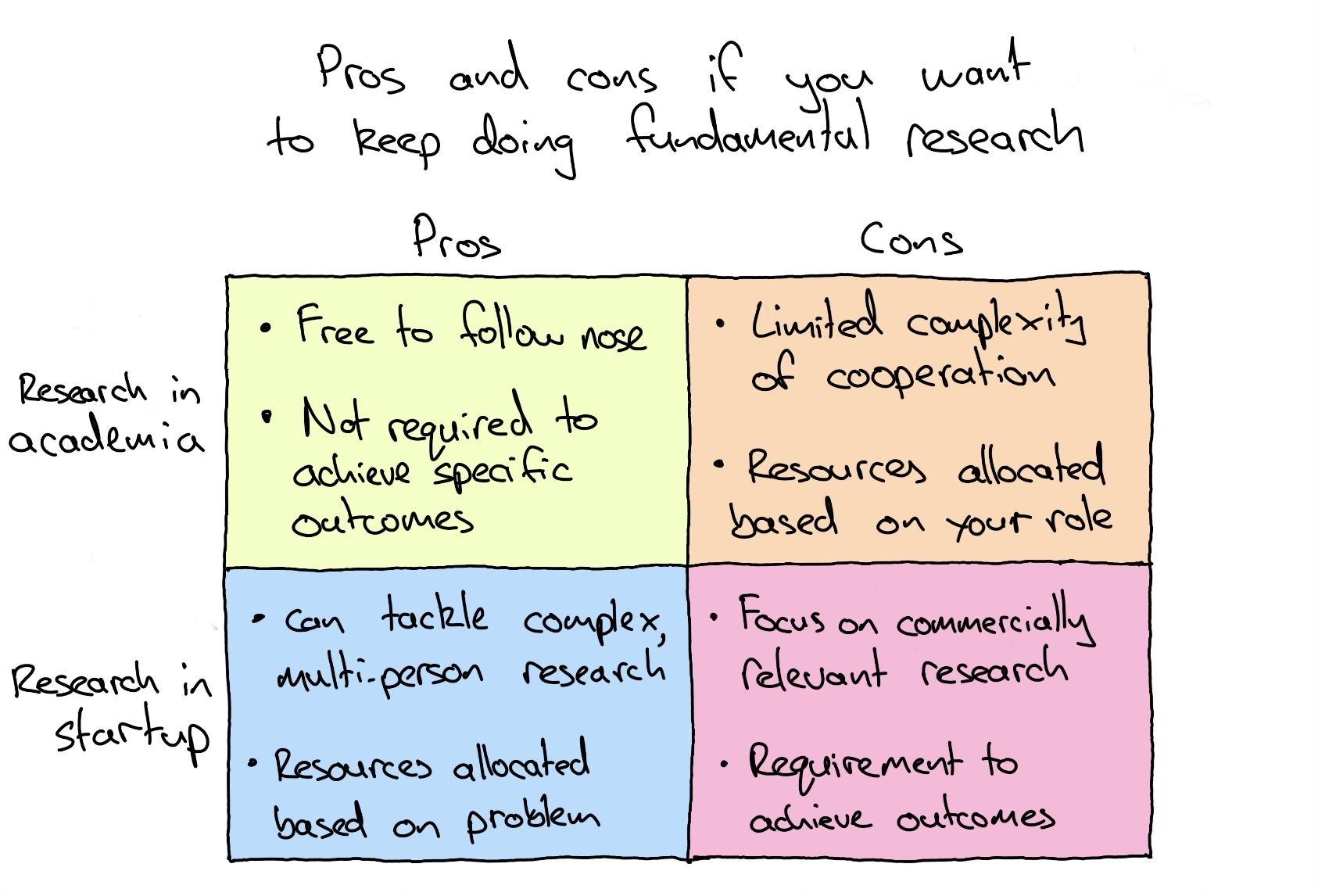
There are a few differences between how research plays out in a company and in academia. In academia you have the advantage that you can follow your nose and explore what you want. Because research is inherently exploratory you are not bound to deliver what you say you will on grants. As long as you are working hard, discovering interesting things, and reporting on them you can continue to do good work.
I see two disadvantages of research in academia. The first is the flip side of not needing to deliver what you say you will. This makes it very difficult to scale to more complex research efforts involving lots of people. When everyone on the project can do what they want, you can’t rely on anyone so the scale of research efforts becomes limited.
The other problem is due to the hierarchy. In academic institutions the amount of resources you can deploy is fundamentally constrained by your role in the organisation. PhD students are limited to their own efforts, friends they can collaborate with, and a small discretionary fund. Post-docs might have a bit more money and a few PhD students and so on. Different research organisations allow different levels of resources and flexibility on this point, as they also exist in their own pyramid of status and access to funding. You can also skirt these limits by bringing in your own external funding. In fact, this is an important step on the journey to being an entrepreneur.
In contrast, companies can attract resources unrelated to your status in the university hierarchy. A startup wins resources based on the scale of the problem it is tackling and how credible the plan is to solve it. These resources to get the job done can come from a much wider range of sources - sales, investors, tax credits, partnerships, as well as research grants. As a start-up CEO you can potentially be managing research efforts of hundreds or thousands of people. Because in a company you need to focus and people need to deliver, it becomes possible to tackle far more complex research challenges where people have complex dependencies on each other.
The disadvantage in a company is that you are not as free to follow your nose, and the penalties for failure to achieve a research goal can sometimes be severe. Lost sales, upset customers, late stressful nights and potential bankruptcy.
My feeling is that this is something that can be managed both in an academic or commercial career. As a professor you can carve out time to keep your hands on the tools and vociferously fight back against the demands of the bureaucracy. As a startup founder you too can spend time on the tools. You can also use the company to fund further research at a university. Supervising PhD students can be very rewarding and it provides a pipeline of potential research breakthroughs and future hires. Obviously, you will need to get the company to a point of sufficient maturity and resource before you can afford this.
FCO #5: The profit motive pollutes and prevents blue-sky research. We are mortgaging our future by pushing researchers to start businesses.
The allocation of pure vs applied research funding is an important and difficult discussion for the country. For the purposes of this essay specifically I think the issue is a red herring. My essay is not trying to convince researchers that have no interest in commercial activity to start companies. If you are passionate about research and have no interest in business that is totally fine. Just be clear eyed about the game you are playing in the university system and get to work doing amazing research. We need to do fundamental research just as we need to start more companies.
This essay is trying to help researchers who are already interested in starting a company navigate the contours of what is holding them back. I want to help commercially curious people start something or move on.
I believe that more companies based on research will accelerate blue-sky research by crystallising tools, directly supporting labs, and ultimately increasing the tax take so we can fund more researchers.
FCO #6: I’m worried that the skills of business are too difficult to acquire. Maybe I should go learn all this first before starting.
This insecurity is very common. When you start a business there will be a firehose of new skills to learn. Everything from hiring people, to doing accounts, to running a sales team, to negotiating legal agreements etc. I’m not going to turn this into a huge list. The insecurity is made worse by the fact you will meet lots of sophisticated business people who learned this stuff so deeply they take it completely for granted.
But this insecurity is exactly wrong.
The reason you have a commercial opportunity in front of you is that you focused on learning something difficult and unique. If you had spent all your time learning at business schools then you would be an MBA or business school graduate. Absolutely nothing wrong with that, but you wouldn’t be in a position to start a company based on your research. Instead, you would be looking around for someone who has such a company that you could join and help.
Feeling insecure about the thing that gives you the ability start a company at all doesn’t make much sense. You are a person. People specialise.
Find and partner with a commercially minded co-founder if you can. Generally, startups need at least one builder and one hustler to get things off the ground. If you can do both, great. If not, partner. People at business schools love meeting technical co-founders with new innovations that they could help bring to market.
Avail yourself of the many part-time courses and community events designed to teach basic business skills to entrepreneurs. These are great networking opportunities and give you the basic foundations for working with specialists later on.
Conclusion
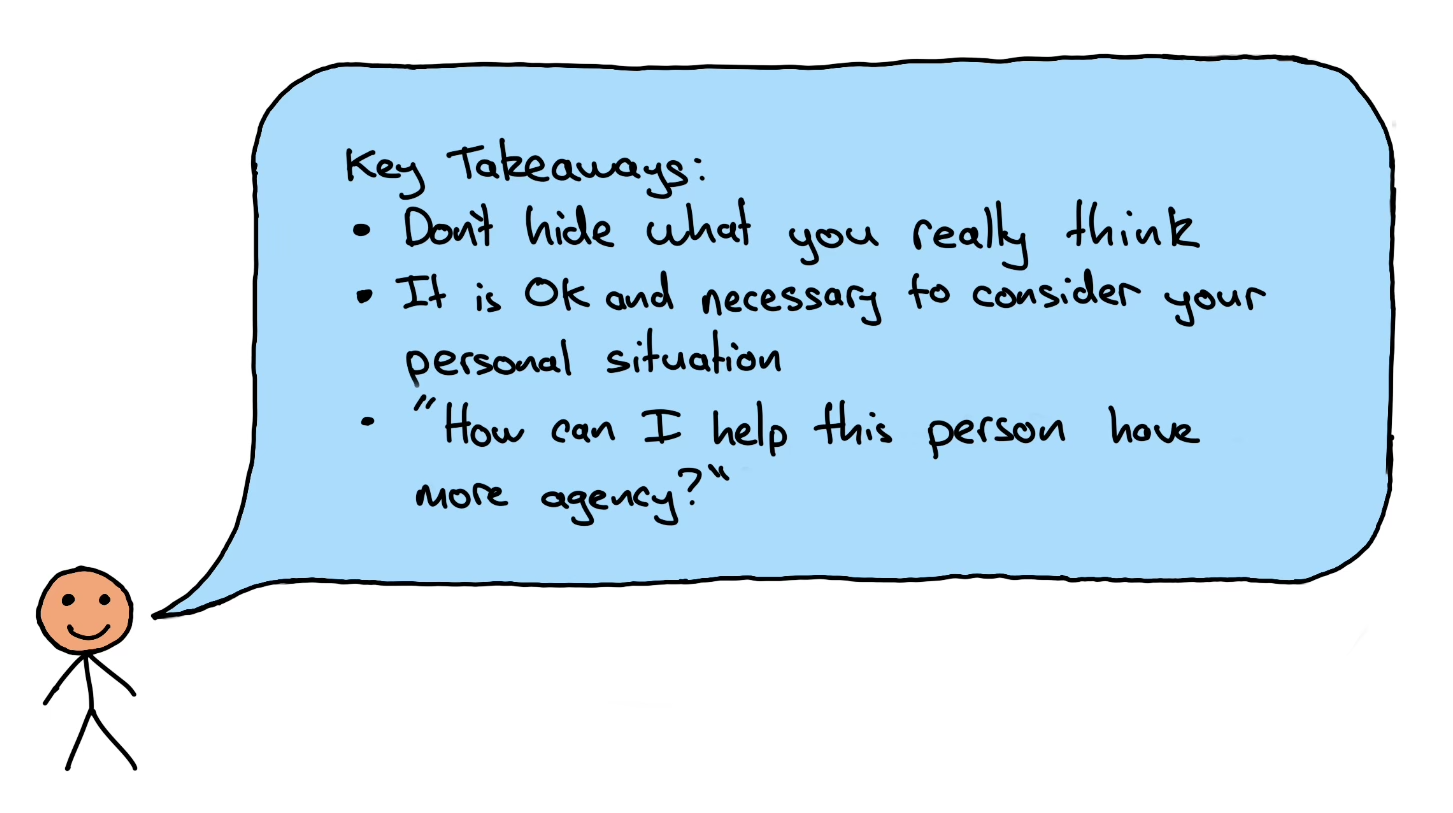
We are now reaching the end of a pretty long essay. As I reflect back on it I think the one key takeaway is; Don’t hide what you really think.
Many commercially curious academics already have a clear idea of what is holding them back. But because they think the startup world wants something different they hide what they think and try to live with the cognitive dissonance. The irony is that the art of building a business is to focus on the actual problems in your way. The less you hide what these are the better you will feel, the more real progress you will make, and the more support and help you will get from others. Experienced business people are candid about real problems and what they are going to do about it.
Another, nearly as important, takeaway is: It is ok and necessary to consider your personal situation when deciding to start a business.
Many people think they have to pretend to be perfect, feel no stress, have no resource constraints, and be some kind of hustling automaton. This is false. Startups can only survive if the plan is at the intersection of sustainable for the business, and sustainable for you. Experienced entrepreneurs plan and manage risk in their personal situation just as much as they do in the business. After all, your risk of burnout or bankruptcy is the business’s key person risk also.
My thoughts in the frequently cited objection section are not the only situations you will face nor is my approach the only way to deal with things. You need to find your own path and every situation is different. If you are worried that you can’t articulate your blockers or don’t know what you don’t know, find a mentor. There are many people who have been through this before and want to help. Every research organisation and university has people whose job is to assist you find mentors to help.
For those in the startup and research ecosystems trying to help my key takeaway is: Every time I talk to a commercially curious academic, how can I help them have more agency?
We are conditioned to focus on helping researchers to see if their business idea is a good one, if there is a market, or if the technology is defensible etc. These are all things that come after academics have made the decision to give entrepreneurship a go. Most of the time researchers haven’t made that decision yet. Most of the time they already know what they need to do. Most of the time they just need to be told:
“You can do this. Don’t wait for permission. Back yourself and work on what is holding you back. You will be amazed how many people want to help”
Thanks for reading my essay,
Ben
Footnotes:
[1] Accelerators, training programs, startup competitions, investors, tech transfer offices, funding bodies, mentors, peer support groups, innovation precincts, corporate incubators etc. So many people are out there wanting to help.
[2] As a whole. For sure there are some excellent people and organisations tacking these issues directly!
[3] For example, if you are pitching for tech transfer funding put your actual barriers on your use of funds slide. It is incredibly powerful to say something like “I am worried there isn’t market for this, so will use funds on a world trip to visit target customers. I have lined up X meetings”.
[4] There is a good book called “Antifragile: Things That Gain From Disorder” by Nassim Nicholas Taleb” that talks all about this.
[5] Particularly a big issue for PhD students. PhD students typically produce 90% of their work in the last 6 months of the thesis. This is because for most of the time before that you are learning new skills and knowledge and building up the infrastructure around the project. You only get to actually generate knowledge towards the end. This is experienced by your thesis supervisor as a sudden miraculous increase in productivity. You go from being a resource sink to a producer of research outputs, and you can also look after more junior members of the group. Starting a company means that right at the moment when they can finally rely on you, you leave.
About me:
Dr Benjamin O’Brien has 20 years experience developing and commercialising technology. Ben has a BE in Mechatronics and PhD in Bioengineering from the University of Auckland. In 2012 he co-founded stretchable sensor company StretchSense and was the CEO for over a decade. Today StretchSense builds and sells the world’s most unobtrusive gloves for XR training and Ben is a director on the board.
Ben believes that technology startups are the key to future economic and social prosperity. To this end he is mentoring founders with a focus on helping them where they are at. This might be confronting the leap of faith, growing a great company, or something else. Ben is writing a book for entrepreneurs, working title “The bottom of the cliff”, that explores recovering from common crises after the mistakes have already been made.
Sign up to the book waitlist here:
https://www.bottomofthecliffbook.com/